

Aviator Game: Complete Guide, How to Play, Rules, Strategy & Betting Tips
If you have come across discussions about online betting games in recent years, chances are you have heard of the Aviator game. It has become one of the most talked-about titles in the crash-game genre, attracting players who appreciate simple mechanics combined with real-time decision-making. This guide is designed to give you a complete, honest, and practical understanding of the Aviator game.
You will learn how the game works, how to place bets, how the multiplier rises and falls, what cashout means, and how to approach the game with a clear head. You will also find detailed sections on bankroll management, common mistakes, and responsible gaming practices.
Before we go any further, one thing must be stated clearly: there is no guaranteed way to win at Aviator. The game is based on random outcomes. No strategy, pattern, or prediction system can reliably tell you when the multiplier will crash. Anyone who claims otherwise is either misinformed or misleading you. This guide is about understanding the game, managing risk, and making informed decisions—not about promising profits.
What Is Aviator Game?
Aviator is a multiplayer crash game developed by Spribe, a well-known iGaming software provider. It was first released in 2019 and has since been integrated into hundreds of online casinos and sportsbooks worldwide. The game belongs to the “crash game” genre, where the core mechanic revolves around a rising multiplier that can end at any moment.

The Basic Concept
In every round of Aviator, a small animated plane takes off from the bottom of the screen. As the plane ascends, a multiplier displayed on the screen climbs steadily upward from 1.00x. The longer the plane stays in the air, the higher the multiplier becomes.
The player’s objective is simple: cash out before the plane flies away (crashes). If you cash out in time, your winnings are calculated by multiplying your stake by the multiplier at the moment you cashed out. If you do not cash out before the plane disappears, you lose your entire stake for that round.
The Rising Multiplier
The multiplier is the heart of the Aviator game. It starts at 1.00x and can climb to values as high as 1,000x or more, though such high multipliers are extremely rare. The multiplier does not follow a predictable pattern. It might climb for just a couple of seconds and crash at 1.10x, or it might soar for twenty seconds and reach 50x before disappearing. Nobody—including the platform or the game provider—knows in advance where the multiplier will stop
The Player's Objective
Your only real decision in each round is when to cash out. You are not competing against other players directly; rather, you are making a personal timing decision. Other players’ bets and cashouts do not affect the multiplier or the crash point. The round is independent, and your outcome depends solely on your own cashout timing relative to the random crash point.
Why Timing Matters
Timing is everything in Aviator because the multiplier rises continuously and the crash point is unknown. Cash out too early, and you secure a smaller multiplier but avoid losing your stake. Cash out too late, and you risk losing everything. There is no “perfect” time to cash out—only a trade-off between risk and potential reward.
How Does Aviator Work?
Understanding the mechanics of a typical Aviator round is essential before you start playing. The game follows a consistent loop that repeats every round.
Round Breakdown
Step-by-step guide to every round
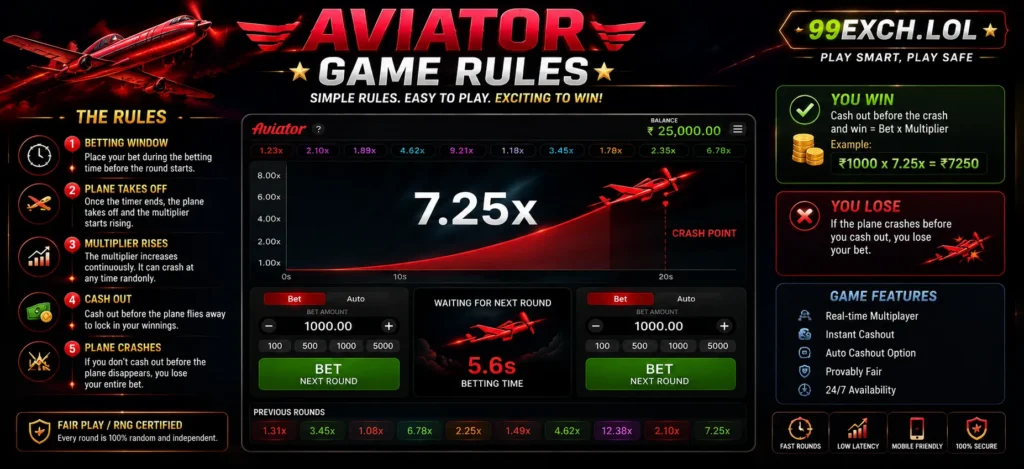
Betting Window
Before each round begins, there is a short betting window, typically lasting 5 to 7 seconds. During this time, you must place your bet(s) for the upcoming round. You can usually place one or two bets per round, each with its own stake amount.
Take-Off
Once the betting window closes, the round starts. The plane takes off, and the multiplier begins climbing from 1.00x. You cannot place new bets after this point; your stake for the round is locked in.
Climb
The multiplier rises continuously. It may start slowly and then accelerate, or it may climb at a relatively steady pace. The behaviour of the multiplier varies from round to round and cannot be predicted.
Cashout Decision
While the multiplier climbs, you have the option to cash out manually by pressing the cashout button. Alternatively, you may have set an auto cashout target beforehand, which will trigger automatically when the multiplier reaches your chosen level.
Crash (Fly-Away)
At a randomly determined moment, the plane disappears from the screen and the round ends. This is the crash point. If you cashed out before the crash, your winnings are calculated based on the multiplier at the time of cashout. If you did not cash out, your stake is lost.
Result Display
After the round ends, the crash multiplier is displayed in the game's history panel. You can review past rounds to see how the multipliers have behaved, but this information does not help predict future rounds.
What Happens If You Don't Cash Out?
If the plane crashes before you cash out, you lose your entire stake for that round. There is no partial refund or consolation prize. The risk of losing your stake is what makes the game exciting, but it also means you must be disciplined about your betting.
Randomness and Provably Fair
Every round of Aviator is determined by a Random Number Generator (RNG). The crash point is generated fresh for each round and is not influenced by previous rounds, the number of players, or the size of bets.
Spribe also implements a provably fair system. This uses cryptographic techniques—server seeds, player seeds, and hashes—to allow players to verify after the round that the result was not altered after bets were placed. In plain terms, the operator cannot change the multiplier mid-round or manipulate the outcome to favour themselves. However, provably fair does not give you any information about future rounds. It only verifies the past.

How to Play Aviator
Complete guide for beginners
Random Number Generator (RNG)
Every round of Aviator is determined by a Random Number Generator (RNG). The crash point is generated fresh for each round and is not influenced by previous rounds, the number of players, or the size of bets.
Provably Fair System — Uses cryptographic techniques (server seeds, player seeds, and hashes) to allow players to verify after the round that the result was not altered after bets were placed. In plain terms, the operator cannot change the multiplier mid-round or manipulate the outcome. However, provably fair does not give you any information about future rounds. It only verifies the past.
Step-by-Step Guide
Open the Game
Navigate to a licensed online casino or sportsbook that offers the authentic Spribe version of Aviator. Look for the game in the casino's game library or dedicated crash-game section. If a demo mode is available, use it first to familiarise yourself with the interface without risking real money.
Understand the Interface
Take a moment to look at the screen. You will typically see:
• The multiplier display in the centre of the screen.
• A betting panel at the bottom where you enter your stake.
• A cashout button that you press when you want to exit the round.
• An auto cashout option where you can set a target multiplier.
• A round history panel showing previous crash multipliers.
• Your current balance.
Select Your Stake
Before the round begins, enter the amount you wish to bet. Some platforms allow you to place two separate bets per round, which can be managed independently. Start with a small stake, especially if you are new to the game. A common rule of thumb is to bet no more than 1–5% of your total bankroll per round.
Place Your Bet
Confirm your stake during the betting window. Once the round begins and the plane takes off, your bet is locked in and cannot be changed.
Watch the Multiplier
As the plane ascends, the multiplier climbs from 1.00x upward. Watch it closely. The multiplier may rise quickly or slowly — there is no way to predict its behaviour.
Cash Out Manually
When you are satisfied with the current multiplier, press the cashout button. Your winnings are calculated as:
For example, if you bet ₹100 and cash out at 2.50x, you receive ₹250. If you cash out at 1.50x, you receive ₹150.
Use Auto Cashout (Optional)
If you prefer not to watch the multiplier continuously, you can set an auto cashout target. For instance, you might set it to 2.00x. When the multiplier reaches 2.00x, your bet is automatically cashed out. This removes the need for split-second timing but also means you may miss out on higher multipliers if the plane continues to climb.
Understand the Final Result
After the round ends, check the result. If you cashed out in time, your winnings are credited to your balance. If you did not, your stake is lost. Review the round history to see the crash multiplier, but remember that past results do not predict future rounds.
Aviator Game Rules
Understand the rules before you play
Game Rules
When Bets Are Accepted
Bets are only accepted during the betting window before each round begins. Once the round starts and the plane takes off, you cannot place new bets or change your stake for that round.
How Rounds Begin
Each round begins with a short countdown. After the countdown ends, the plane takes off and the multiplier starts climbing from 1.00x.
How the Multiplier Changes
The multiplier changes continuously and unpredictably during the round. It is determined by a Random Number Generator and is not influenced by any external factors.
What Cashout Means
Cashout is the action of ending your bet before the round ends. When you cash out, your winnings are locked in at the current multiplier. You cannot cash out after the plane has crashed.
When the Round Ends
The round ends when the plane flies away (crashes). At that moment, the multiplier stops climbing. Any player who has not cashed out loses their stake for that round.
How Winnings Are Calculated
Winnings are calculated as:
If you cash out at 3.00x on a ₹200 stake, you receive ₹600. If you cash out at 1.20x, you receive ₹240.
What Happens When a Player Does Not Cash Out
If you do not cash out before the crash, you lose your entire stake. There is no partial refund or grace period.
Aviator Game Interface Explained
The interface of Aviator is designed to be clean and intuitive. Here are the main elements you will encounter.
Multiplier Display
Central element showing the current multiplier. Starts at 1.00x and increases as the plane ascends.
Betting Panel
Located at the bottom, allows you to enter your stake and confirm your bet. Some platforms allow two bets simultaneously.
Cashout Button
Press to exit the round and lock in your winnings. Large and positioned for easy access.
Auto Cashout
Set a target multiplier. When reached, your bet is automatically cashed out. Removes the pressure of manual timing.
Round History
Shows crash multipliers from previous rounds. For reference only — does not provide predictive information.
Balance Display
Shows your current account balance. Keep an eye on it to stay aware of your available funds.
Previous-Round Indicators
Displays crash multipliers of recent rounds as small dots or bars on the graph. For reference only.
How the Aviator Multiplier Works
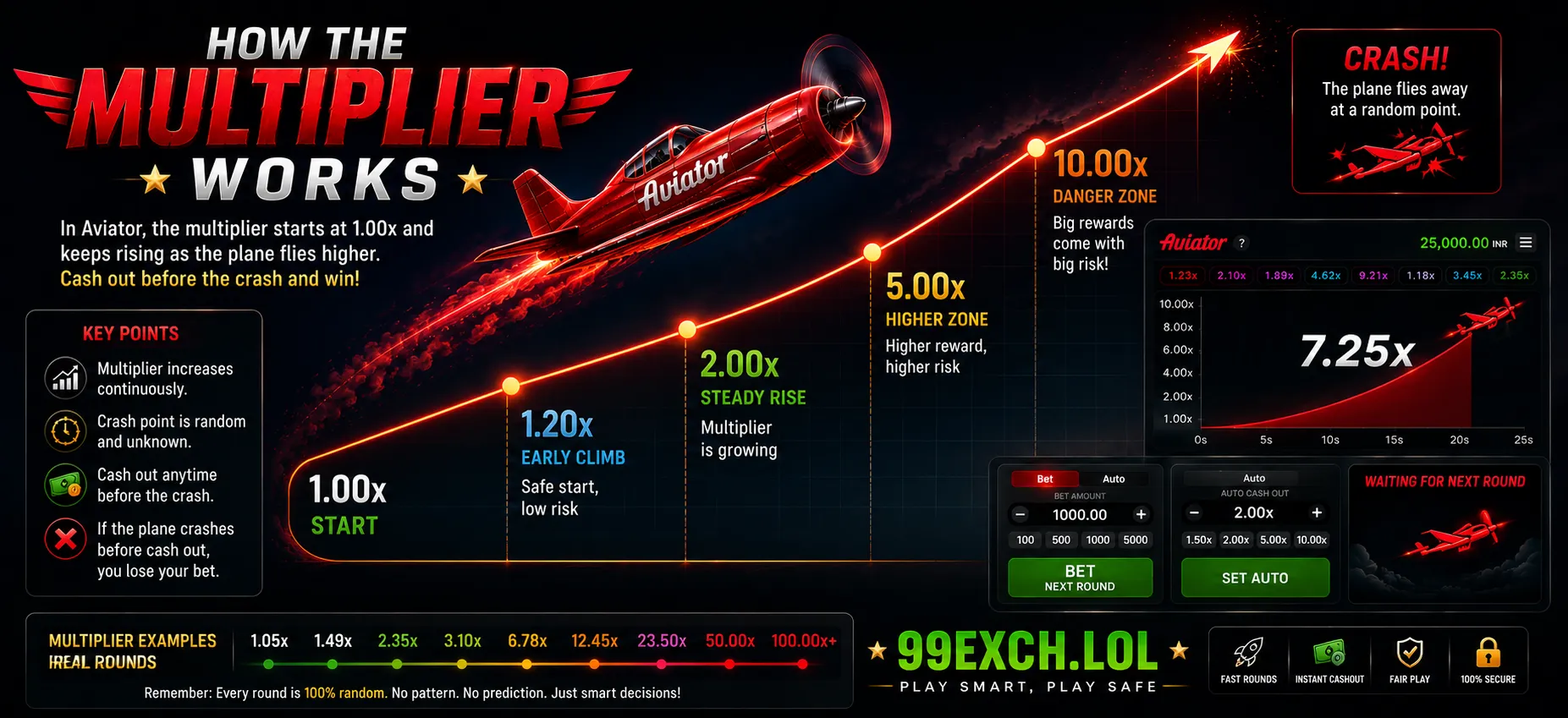
The multiplier is the central mechanic of the Aviator game. Understanding how it behaves is essential for making informed decisions.
Multiplier Mechanics
The multiplier starts at 1.00x at the beginning of each round. It increases over time, often non-linearly—it may start slowly and then accelerate. The multiplier can reach very high values, but high multipliers are rare
Simple Examples
If you bet ₹100 and cash out at 1.50x, you receive ₹150.
If you bet ₹100 and cash out at 3.00x, you receive ₹300.
If you bet ₹100 and the plane crashes at 2.00x before you cash out, you receive nothing.
What the Multiplier Does NOT Do
The multiplier does not follow patterns. It does not alternate between high and low values in a predictable sequence. It is not influenced by how many players are betting or how much they are wagering. Each round is independent, and the multiplier is generated fresh each time.
A Note on Probability
The probability of the multiplier reaching a particular level decreases as the target increases. For example, lower multipliers like 1.10x or 1.20x occur more frequently, while multipliers above 5.00x occur less often. However, this does not mean that a high multiplier is “due” after a series of low multipliers. Each round is independent, and past results do not affect future outcomes.

How to Place an Aviator Bet
Placing a bet in Aviator is straightforward, but there are a few things to keep in mind.
For Beginners
Choose a licensed platform that offers the authentic Spribe version of Aviator.
Start with a small stake—something you are comfortable losing.
Use the demo mode if available to practice without risk.
Watch a few rounds without betting to understand how the multiplier behaves.
Place your first bet during the betting window.
Cash out early in your first few rounds to get a feel for the process.
Stake Selection
Your stake is the amount you wager on each round. It should be a small percentage of your total bankroll. Betting too much per round increases the risk of losing your funds quickly. A common recommendation is to bet 1–5% of your bankroll per round.
Timing Considerations
You must place your bet during the betting window before the round starts. You cannot place bets or change your stake once the plane has taken off.
How to Cash Out in Aviator
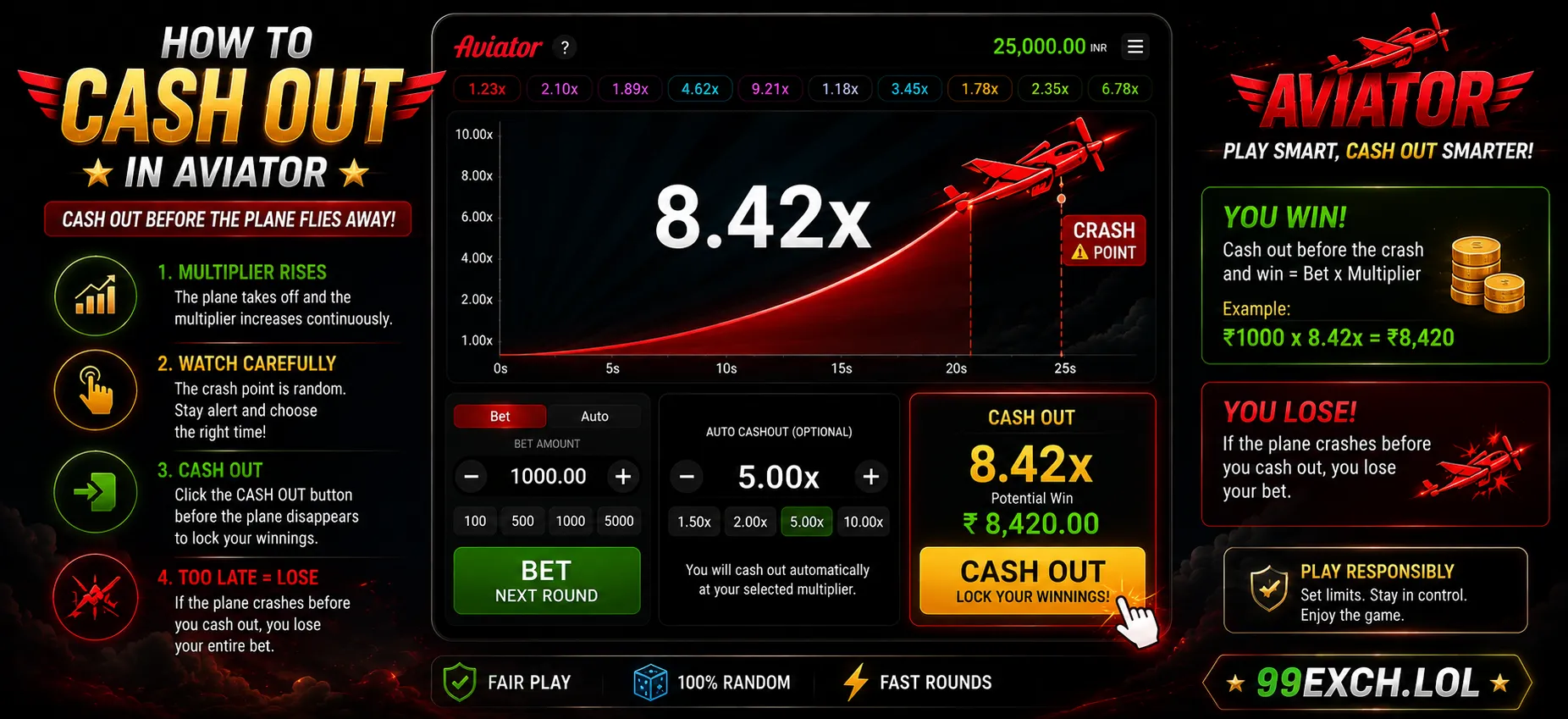
Cashing out is the action that determines whether you win or lose in a round. There are two primary ways to cash out: manually and automatically.
Manual Cashout
Manual cashout requires you to press the cashout button while the multiplier is climbing. The timing is entirely up to you. This gives you full control over your exit point but also requires quick decision-making under pressure.
Auto Cashout
Auto cashout allows you to set a target multiplier in advance. When the multiplier reaches that level, your bet is automatically cashed out. This removes the need for split-second timing and can help you stick to a pre-defined plan.
The Difference
The main difference between manual and auto cashout is control versus convenience. Manual cashout gives you the flexibility to adjust your exit based on how the round feels, but it also introduces the risk of emotional decision-making. Auto cashout removes emotion from the equation but may cause you to miss out on higher multipliers if the plane continues to climb.
Manual Cashout vs Auto Cashout
| Feature | Manual Cashout | Auto Cashout |
|---|---|---|
| Control | Full control over exit timing | Pre-set target; no manual intervention |
| Emotion | Subject to emotional decisions | Removes emotional bias |
| Speed | Requires quick reaction | Instant when target is reached |
| Flexibility | Can adjust based on round behaviour | Fixed target; cannot change mid-round |
| Suitable For | Players who enjoy active decision-making | Players who prefer a disciplined, systematic approach |
Advantages and Disadvantages
Manual Cashout Advantages:
You can react to the multiplier in real time.
You have the flexibility to cash out earlier or later based on the round.
Manual Cashout Disadvantages:
You may hesitate and miss the optimal exit point.
Emotional pressure can lead to poor decisions.
Auto Cashout Advantages:
You stick to a pre-defined plan.
You avoid the stress of manual timing.
Auto Cashout Disadvantages:
You may cash out too early if the plane would have climbed higher.
You cannot adjust your target based on how the round develops.
Single Bet vs Multiple Bets
Some versions of Aviator allow you to place two separate bets in the same round. This can be used in different ways.
How Multiple Bets Work
You can place two bets with different stakes and different cashout strategies. For example, you might place one bet with a conservative auto cashout at 1.50x and another bet with a higher target, hoping for a larger multiplier.
Strategic Use
Conservative + Aggressive: One bet cashes out early for a small but consistent return, while the other aims for a higher multiplier.
Risk Distribution: By splitting your stake, you can manage risk more effectively.
Important Note
Multiple bets do not change the underlying randomness of the game. They simply allow you to diversify your approach within a single round. Do not assume that placing two bets increases your overall chances of winning—the crash point is still random, and both bets are subject to the same risk.
Aviator Betting Strategy
Before discussing strategies, it is important to state clearly: no strategy can guarantee a win in Aviator. The game is based on random outcomes, and the crash point cannot be predicted. Strategies are about managing risk, not eliminating it.
Predefined Cashout Targets
One common approach is to set a fixed cashout target for every round. For example, you might decide to always cash out at 2.00x. This removes the need for in-the-moment decision-making and helps you maintain consistency. However, it also means you will sometimes cash out before a round reaches a higher multiplier, and you may lose your stake if the round crashes below your target.
Consistent Stake Sizing
Keeping your stake consistent from round to round is another way to manage risk. If you vary your stake based on emotions or recent results, you increase the risk of significant losses. A consistent stake helps you stay within your budget.
Avoiding Emotional Decisions
Emotions are one of the biggest challenges in Aviator. The fast pace of the game can make you feel pressured to cash out or stay in longer. Setting clear rules for yourself—such as a fixed cashout target or a loss limit—can help you avoid impulsive decisions.
Session Limits
Decide in advance how long you will play and how much you are willing to spend in a session. Once you reach your limit, stop playing. This prevents you from chasing losses or playing longer than intended.
Bankroll Management
Bankroll management is the most important aspect of any betting strategy. It involves setting a budget, choosing appropriate stake sizes, and sticking to your limits. We will cover this in more detail in the next section.
Stopping Rules
Establish clear stopping rules before you start playing. For example:
Stop after a certain number of rounds.
Stop if you lose a predetermined amount.
Stop if you reach a profit target.
Low-Risk and High-Risk Approaches
Different players have different risk tolerances. Here is how low-risk and high-risk approaches generally compare.
Low-Risk Approach
A low-risk approach involves cashing out early at relatively low multipliers, such as 1.10x to 1.50x. This increases the frequency of winning rounds but limits the size of each win. It is a conservative strategy that prioritises avoiding losses over chasing big payouts.
Advantages: More consistent results, lower volatility.
Disadvantages: Smaller wins, may not keep pace with inflation or platform fees.
High-Risk Approach
A high-risk approach involves aiming for higher multipliers, such as 2.00x, 5.00x, or even higher. This reduces the frequency of winning rounds but offers the potential for larger payouts.
Advantages: Potential for significant wins.
Disadvantages: Higher volatility, more frequent losses, higher risk of depleting your bankroll.
Important Note
Neither approach is “safe” or “guaranteed.” Both involve risk. Lower multipliers may still result in losses if the round crashes before you cash out. Higher multipliers are less likely to occur, and the probability of a crash before reaching a high target is substantial.
Aviator Bankroll Management
Effective bankroll management is the foundation of sustainable play. Without it, even the best strategy will not protect you from significant losses.
Setting a Budget
Before you start playing, decide how much money you are willing to set aside for Aviator. This amount should be separate from your essential expenses—rent, bills, groceries, and savings should never be used for betting.
Stake Sizing
A common recommendation is to bet no more than 1–5% of your bankroll per round. For example, if your bankroll is ₹10,000, you might bet between ₹100 and ₹500 per round. This ensures that a series of losing rounds does not wipe out your entire bankroll.
Session Limits
Set a limit for each playing session. For instance, you might decide to stop after 20 rounds or after losing 20% of your bankroll. This prevents you from getting caught up in the game and losing more than you intended.
Loss Limits
A loss limit is the maximum amount you are willing to lose in a single session. Once you reach that limit, stop playing immediately. This helps you avoid chasing losses, which is one of the most common mistakes in betting.
Avoiding Chasing Losses
Chasing losses means trying to recover lost money by betting more or taking bigger risks. This almost always leads to further losses. Accept that losses are part of the game and stick to your pre-defined limits.
Keeping Betting Money Separate
Keep your betting money separate from your day-to-day finances. This makes it easier to track your spending and prevents you from accidentally using money that you need for other purposes.
Common Aviator Mistakes
Even experienced players can fall into traps. Here are some of the most common mistakes to avoid.
Chasing Losses
One of the most damaging mistakes is trying to recover losses by increasing your stake or taking bigger risks. This often leads to even larger losses. Stick to your budget and accept that some rounds will not go your way.
Increasing Stakes After Losses
Increasing your stake after a loss is a form of chasing losses. It assumes that a win is “due,” which is not how random games work. Each round is independent, and increasing your stake does not improve your chances of winning.
Assuming Patterns
Many players look at the round history and try to find patterns, such as “the multiplier has been low for several rounds, so a high one must be coming.” This is a fallacy. The crash point is random, and past results do not predict future outcomes.
Believing Previous Rounds Predict the Next
This is closely related to the pattern fallacy. Some players believe that a long streak of low multipliers means a high multiplier is imminent. This is not true. Each round is independent, and the crash point is generated fresh each time.
Ignoring Bankroll Limits
Failing to set or stick to bankroll limits is a common mistake. Without limits, it is easy to lose track of how much you are spending and end up with significant losses.
Playing Emotionally
Emotions such as excitement, frustration, or greed can cloud your judgment. If you find yourself making decisions based on how you feel rather than a clear plan, it is time to take a break.
Using Unrealistic Profit Targets
Setting unrealistic profit targets can lead to disappointment and poor decision-making. Aim for consistent, manageable returns rather than chasing massive payouts.
How to Read Previous Aviator Rounds
The round history panel shows the crash multipliers from previous rounds. It is a useful reference, but it is important to interpret it correctly.
What the History Panel Shows
The history panel typically displays the crash multiplier for each recent round. You might see values like 1.23x, 3.45x, 1.01x, 2.10x, and so on.
What It Does NOT Show
The history panel does not show any information that can help you predict the next round. The crash point is random, and past multipliers do not influence future multipliers.
Why It Is Still Useful
Reviewing the history can help you understand the game’s volatility and the range of multipliers that typically occur. It can also help you calibrate your expectations—for example, you might notice that multipliers below 2.00x are common, while multipliers above 5.00x are rare.
Aviator Odds and Probability
Understanding the odds and probability in Aviator can help you make more informed decisions, but it does not give you a winning edge.
Randomness and Probability
Aviator is a game of chance. The crash point is determined by a random number generator, and the probability of the multiplier reaching a particular level decreases as the target increases.
What the Numbers Mean
Multipliers between 1.00x and 1.50x occur relatively frequently—roughly 60% of the time.
Multipliers between 1.50x and 2.00x occur less frequently—around 25% of the time.
Multipliers above 2.00x occur less often—approximately 15% of the time.
These are approximate figures and may vary between platforms and over time.
What Probability Does NOT Mean
Probability does not mean that a particular multiplier is “due” to occur. Each round is independent, and the probability of a crash at a specific level remains the same regardless of what happened in previous rounds.
Does Aviator Have a Winning Formula?
The short answer is no. There is no formula, system, or strategy that can guarantee a win in Aviator.
Why No Formula Exists
Aviator is based on random outcomes. The crash point is generated fresh for each round using a random number generator. No amount of analysis, pattern recognition, or mathematical modelling can predict where the multiplier will stop.
What You Can Control
You can control your stake size, your cashout timing, and your bankroll management. These factors influence how you experience the game, but they do not change the underlying randomness.
Risk Management, Not Prediction
The most effective approach to Aviator is not about predicting the crash point—it is about managing risk. This means setting limits, sticking to a budget, and making disciplined decisions.
Aviator Myths vs Facts
Common misconceptions debunked
Aviator Tips for Beginners
Start your Aviator journey on the right foot
Advanced Aviator Tips
Refine your strategy and elevate your game
Aviator Mobile Experience
Play on the go with the same thrill
Mobile Usability
The game is designed to be responsive, meaning it adapts to different screen sizes. The controls are optimised for touch, making it easy to place bets and cash out with a tap.
Responsive Gameplay
Mobile gameplay is generally smooth, with the multiplier display and betting panel clearly visible on the screen. The fast-paced nature of the game translates well to mobile devices, allowing you to play on the go.
Considerations
Aviator App / Platform Access
Aviator is not a standalone app that you download directly from an app store. It is a game module that runs inside licensed online casinos and sportsbooks.
How to Access Aviator
To play Aviator, you need to register with a licensed platform that offers the game. Look for platforms that explicitly mention Spribe’s Aviator in their game library.
Important Note
There is no official standalone Aviator app by Spribe on Google Play or the Apple App Store. Any app that claims to be the “official Aviator app” should be treated with caution. Always verify that you are playing on a licensed and reputable platform.
Aviator Deposit Guide
To play Aviator for real money, you need to deposit funds into your chosen platform. The deposit process varies by platform but generally follows these steps.
General Deposit Concepts
Log in to your account on the platform.
Navigate to the deposit or cashier section.
Choose a payment method that is available in your region (e.g., UPI, bank transfer, e-wallet).
Enter the amount you wish to deposit.
Confirm the transaction.
Important Considerations
Check the platform’s minimum and maximum deposit limits.
Be aware of any transaction fees.
Ensure the platform uses secure encryption for financial transactions.
For a detailed step-by-step guide, see the 99Exch Deposit Guide
Aviator Withdrawal Guide
Withdrawing your winnings from Aviator follows the same process as withdrawing from any other game on the platform.
General Withdrawal Concepts
Log in to your account.
Navigate to the withdrawal section.
Select your preferred withdrawal method.
Enter the amount you wish to withdraw.
Confirm the transaction.
Important Considerations
Withdrawal times vary by method and platform.
You may need to complete KYC (Know Your Customer) verification before your first withdrawal.
Check the platform’s withdrawal limits and any applicable fees.
For detailed instructions, refer to the 99Exch Withdrawal Guide
Aviator Bonus and Promotions
Many platforms offer bonuses and promotions that can be used on Aviator. These vary widely, so it is important to read the terms and conditions carefully.
Types of Promotions
Welcome bonuses: Often match your first deposit up to a certain percentage.
Free bets: Some platforms offer free bets that can be used on specific games.
Cashback: A percentage of your losses may be returned to you as bonus funds
Important Considerations
Bonuses usually come with wagering requirements, meaning you must bet the bonus amount a certain number of times before you can withdraw winnings.
Not all games contribute equally to wagering requirements.
Promotions are subject to change and may have expiration dates.
For the latest offers, check the 99Exch Bonus Offers page
Aviator and Casino Games
Aviator differs significantly from traditional casino games like slots, roulette, or blackjack.
Key Differences
Active decision-making: In Aviator, you actively decide when to cash out. In slots, you simply spin and wait for the result.
Multiplier-based: Aviator is based on a rising multiplier, whereas slots are based on symbol combinations.
Social element: Aviator is a multiplayer game where you can see other players’ bets and cashouts in real time.
Similarities
Both involve risk and chance.
Both are governed by random number generators.
Both are offered by licensed online casinos.
For a broader look at casino-style games, see the Live Casino Games page
Aviator and Sports Betting
Aviator and sports betting are fundamentally different forms of betting.
Differences
Randomness: Aviator outcomes are entirely random, while sports betting involves analysing teams, players, and match conditions.
Timeframe: Aviator rounds last seconds, while sports events last minutes or hours.
Skill vs Chance: Sports betting involves some skill and analysis, while Aviator is purely chance.
Similarities
Both involve risking money on an uncertain outcome.
Both require bankroll management.
Both are offered by many of the same platforms.
For more on sports betting, explore the Betting Exchange and Cricket Betting pages
Aviator and Live Betting
Live betting involves placing bets on a sports event while it is in progress. Aviator, despite its real-time nature, is not live betting in the traditional sense.
Differences
Live betting: Odds change based on the unfolding action in a sports event.
Aviator: The multiplier changes based on a random number generator, not on any external event.
Similarities
Both involve real-time decision-making.
Both can be fast-paced.
For live sports betting, visit the Live Betting Hub page
Aviator and 99Exch Cricket ID

If you are using a platform that offers both Aviator and cricket betting, you may use the same account credentials to access both. Your 99Exch Cricket ID can be used to log in to the platform and access Aviator, subject to the platform’s offerings.
Aviator Mobile Access
For mobile access to Aviator, you can use the platform’s mobile-optimised website or, if available, a dedicated mobile app. The 99Exch App Download \may provide access to Aviator and other games, depending on the platform’s features.
Responsible Gaming
Responsible gaming is the most important part of any betting activity. Aviator is fast-paced and can be exciting, but it is essential to approach it with a clear plan and healthy boundaries.
Set a Budget
Decide how much money you are willing to spend on Aviator before you start playing. This amount should be separate from your essential expenses—rent, bills, groceries, and savings should never be used for betting.
Never Use Essential Money
Only bet money that you can afford to lose. Never use money that you need for essential living expenses.
Don’t Chase Losses
Chasing losses is one of the most common and damaging mistakes in betting. If you lose a few rounds, accept it and stop playing. Trying to recover losses by increasing your stake or taking bigger risks almost always leads to further losses.
Take Breaks
The fast pace of Aviator can be intense. Take regular breaks to rest your mind and avoid impulsive decisions.
Stop When Limits Are Reached
Set limits for yourself before you start playing. For example:
Stop after a certain number of rounds.
Stop if you lose a predetermined amount.
Stop if you reach a profit target.
Once you reach your limit, stop playing immediately
Understand That Gambling Involves Risk
Every bet you place involves risk. There is no guaranteed way to win, and you should never assume that you will win back what you have lost.
Seek Help If Needed
If you feel that gambling is becoming difficult to control, seek help from professional organisations. Many platforms also offer responsible gaming tools, such as deposit limits, loss limits, and self-exclusion options.
Frequently Asked Questions (FAQ)
1. What is the Aviator Game?
Aviator is a multiplayer crash game developed by Spribe. Players bet on a rising multiplier and must cash out before the multiplier crashes. The game is based on random outcomes, and there is no guaranteed way to win.
2. How do you play Aviator?
To play Aviator, place a bet during the betting window, watch the multiplier climb, and cash out before the plane flies away. If you cash out in time, you win your stake multiplied by the current multiplier. If you do not cash out, you lose your stake.
3. What is the Aviator multiplier?
The multiplier is the number that climbs from 1.00x upward during each round. Your winnings are calculated by multiplying your stake by the multiplier at the time you cash out.
4. How does cashout work?
Cashout is the action of ending your bet before the round ends. You can cash out manually by pressing the cashout button, or you can set an auto cashout target that triggers automatically when the multiplier reaches your chosen level.
5. What is auto cashout?
Auto cashout is a feature that allows you to set a target multiplier. When the multiplier reaches that target, your bet is automatically cashed out. This removes the need for manual timing.
6. Can previous rounds predict the next round?
No. Each round is independent, and past results do not influence future outcomes.
7. Is there a guaranteed Aviator strategy?
No. There is no strategy that can guarantee a win in Aviator. The game is based on random outcomes, and the crash point cannot be predicted.
8. What is bankroll management?
Bankroll management is the practice of setting a budget, choosing appropriate stake sizes, and sticking to your limits. It is the most important aspect of sustainable play.
9. Can beginners play Aviator?
Yes. Aviator is simple to learn, and many platforms offer a demo mode that allows beginners to practice without risking real money.
10. What happens if I don’t cash out?
If you do not cash out before the plane crashes, you lose your entire stake for that round.
11. Is Aviator a casino game?
Yes, Aviator is a casino-style crash game offered by many online casinos and sportsbooks.
12. Can Aviator be played on mobile?
Yes. Aviator is designed to be responsive and works well on mobile devices. Some platforms also offer dedicated mobile apps.
13. How do deposits work?
Deposits are made through the platform where you are playing. You can use payment methods such as UPI, bank transfer, or e-wallets. See the 99Exch Deposit Guide for more details.
14. How do withdrawals work?
Withdrawals are processed through the platform. You may need to complete KYC verification before your first withdrawal. See the 99Exch Withdrawal Guide for more details.
15. Are bonuses guaranteed?
Bonuses and promotions vary by platform and are subject to terms and conditions. They are not guaranteed and may have wagering requirements.
Final Verdict
Aviator is a simple yet engaging crash game that has gained widespread popularity for its fast-paced, multiplayer format. The game revolves around a single decision: when to cash out. The multiplier rises unpredictably, and the crash point is random. No strategy can guarantee a win, and any claim to the contrary should be treated with scepticism.
The key to enjoying Aviator is to approach it with discipline. Set a budget, choose appropriate stake sizes, and stick to your limits. Use the demo mode to practice, and do not chase losses. Remember that gambling involves risk, and you should never bet money that you cannot afford to lose.
Aviator is a game of chance, and the most important factor in your experience is not the multiplier or the crash point—it is your own decision-making and bankroll management. Play responsibly, and the game can be an entertaining addition to your online betting activities. 99exch